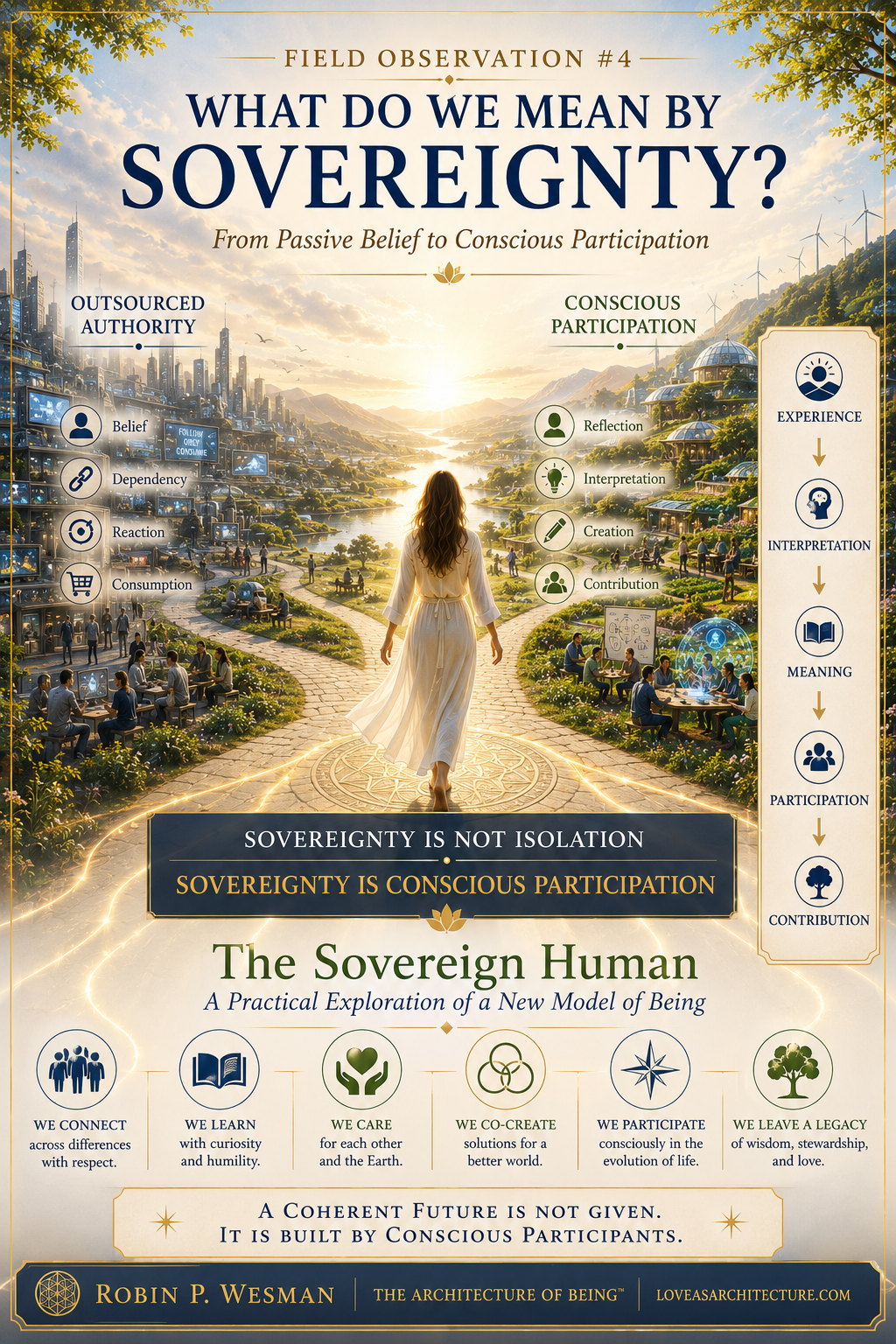
What Do We Mean by Sovereignty?
From Passive Belief to Conscious Participation
As I prepared to publish The Sovereign Within, I realized something unexpected.
The word "sovereignty" appears throughout my work, yet I had never stopped to explicitly define what I meant by it.
The assumption was always there.
The idea was present in the background.
But the definition itself remained largely unspoken.
This observation emerged from a simple question:
What do we actually mean when we speak of sovereignty?
For many people, the word immediately evokes images of politics, independence, personal freedom, or self-rule.
Others may associate it with spirituality, self-mastery, or the journey of the soul.
While each of these perspectives contains elements of truth, I have come to believe that sovereignty points toward something deeper and more practical.
It points toward participation.
Beyond the Outsourced Life
Much of modern life encourages us to outsource our authority.
We outsource our thinking to experts.
We outsource our beliefs to institutions.
We outsource our identity to social systems.
We outsource our meaning to cultural narratives.
We outsource our direction to those who claim to know the way.
Over time, we can become highly informed and yet strangely disconnected from our own lived experience.
We consume more information.
We seek more answers.
We follow more authorities.
Yet the fundamental questions remain:
What do I actually think?
What have I learned from my own life?
What do I have to offer?
These questions cannot be answered by another person.
They require participation.
The Human at the Core
One of the foundational ideas throughout my work is what I call Human at the Core.
This principle suggests that while technology, institutions, teachers, books, and even AI can provide support, they should never replace the human capacity for interpretation.
Experience alone does not create wisdom.
Events alone do not create meaning.
Information alone does not create understanding.
Something else is required.
Interpretation.
Reflection.
Participation.
Meaning emerges through the relationship between experience and awareness.
This is where sovereignty begins.
A New Model of the Human Being
For centuries, many cultures have understood human beings through the language of the soul.
The soul has provided an important framework for understanding identity, purpose, morality, and transcendence.
Yet we now find ourselves living in a world shaped by globalization, digital technologies, artificial intelligence, systems thinking, and increasing complexity.
New questions are emerging.
Questions that demand new models.
What if being human is not merely about discovering who we are?
What if it is also about consciously participating in reality?
What if meaning is not simply found?
What if it is co-created?
What if wisdom is not delivered?
What if it emerges through engagement?
These questions point toward a different possibility.
The possibility of the Sovereign Human.
Sovereignty as Conscious Participation
For me, sovereignty is not isolation.
It is not separation.
It is not superiority.
It is not rebellion.
Sovereignty is the capacity to consciously participate in the creation, interpretation, and expression of one's own reality while remaining in relationship with the larger whole.
A sovereign person does not withdraw from life.
They engage more deeply with it.
They recognize that experience requires interpretation.
Interpretation creates meaning.
Meaning shapes participation.
Participation generates contribution.
Contribution becomes legacy.
This is not a destination.
It is an ongoing process.
A living practice.
The Choice Point
Every human being encounters moments when they must choose.
Do I simply adopt the interpretations of others?
Or do I participate in creating my own understanding?
Do I consume endlessly?
Or do I create?
Do I remain a spectator?
Or do I become a participant?
This choice point appears repeatedly throughout life.
It appears in relationships.
In careers.
In communities.
In spirituality.
In education.
And increasingly, it appears in our relationship with technology.
The question is not whether tools will influence us.
The question is whether we will remain conscious participants in how those tools are used.
The Sovereign Within
Perhaps this is the deeper purpose behind The Sovereign Within.
The book is not fundamentally about artificial intelligence.
Nor is it simply about capturing memories, documenting experiences, or preserving personal stories.
At its heart, the book is an invitation.
An invitation to recover authorship.
To explore your experiences.
To identify your patterns.
To recognize your gifts.
To uncover your wisdom.
And to discover how your unique contribution might be shared with others.
In this sense, sovereignty is not something we possess.
It is something we practice.
Each time we reflect.
Each time we interpret.
Each time we create.
Each time we contribute.
We participate in becoming more fully human.
And perhaps that is what sovereignty ultimately points toward:
Not independence.
Not certainty.
But conscious participation in the ongoing creation of a meaningful life.
I think this is exactly the kind of observation that can later become:
the Prologue to The Sovereign Within
the opening section of a future white paper, The Sovereign Human
and eventually a foundational statement for the entire Architecture of Being framework.